⚡ Quick take
A website builder gets you online fast and cheap, but it sets a ceiling on speed, SEO and design — and you cannot raise that ceiling later, only move house. Custom development costs more and takes longer, but the code is yours and grows with the business. It comes down to one thing: how many years the site has to live.
The website builder vs custom development question usually comes up before anyone has decided what the site is actually for, and the answer determines whether you will be rebuilding everything from scratch a year later.
What a website builder is
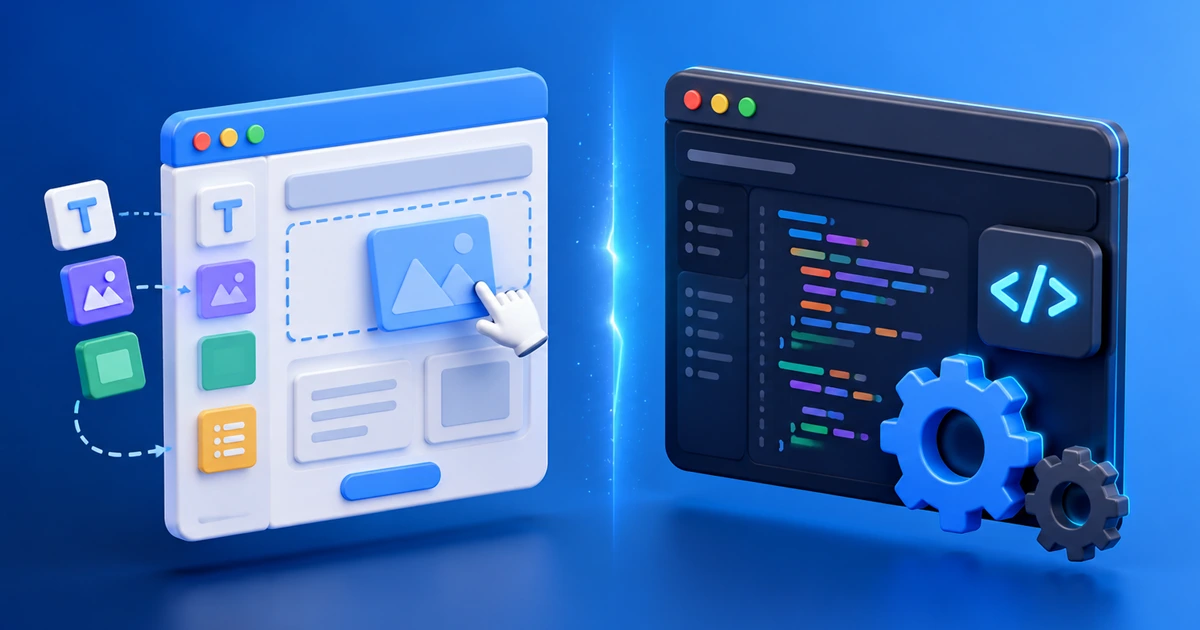
A website builder is an online platform (Wix, Tilda, Squarespace and others) where pages are assembled from ready-made blocks in a visual editor, without writing code. Hosting, an SSL certificate and basic support are included in the subscription: you pay for access to a tool, not for development work.
Ready-made website templates are the core of the model. You pick one, swap the text and images, move blocks around, and publish. All the complexity sits inside the platform — which is both its strength and its limit. A web builder assembles your site from the set of pieces its makers anticipated; anything outside that set is either unavailable or reached through workarounds.
What it actually costs
Nearly every platform has a free tier. On it you normally get an address like yourproject.platform.com, a service banner at the bottom of the page, and basics locked away — a custom domain, payment collection. Fine for testing an idea, not for a business.
The real cost is the subscription you pay every month for as long as the site exists. Over two or three years the total becomes noticeable, and nothing remains of it: stop paying and the site is gone. Development is paid once, after which you only cover hosting and the domain. Compare the total across the years the site will actually run, not the price this month.
Where a builder genuinely wins
- Fast start. A page can be assembled and published in a day or two, with no contractor to find and no schedules to align.
- Low barrier. No technical knowledge required — the interface is built for someone who has never seen code.
- Everything in one place. Hosting, certificate and a contact form are already wired in; you do not go looking for them separately.
- Edits without a middleman. Changing a price or a paragraph takes a minute and does not depend on anyone else's availability.
Limits worth knowing upfront
- Loading speed. The platform ships universal code covering every scenario it supports, so pages load noticeably slower than ones written for a specific job. On mobile data the gap is easy to feel.
- An SEO ceiling. Less control over the technical layer: URL structure, speed, some meta tags on lower plans. Competing for commercial queries gets harder, and you tend to hit this ceiling exactly when the business starts growing.
- Platform lock-in. Moving a finished site to your own hosting is close to impossible — the design and structure stay inside the service. Migration means rebuilding.
- Someone else's template underneath. Even after customisation the site stands on a template thousands of others have used. Making it genuinely yours is hard.
- The service sets the rules. Pricing, terms and available features change when the platform decides, and your opinion is not part of that decision.
Not sure which option fits?
Describe the task — we'll tell you honestly whether a builder is enough or custom development makes more sense.
What about AI builders
Every major platform now offers an ai website builder: you answer a few questions and get a finished page in minutes. It genuinely saves time on the first draft, and for a simple brochure site the result is often good enough to publish.
What it does not change is everything described above. Ai website design produces a layout, not an exception from the platform's limits — the same speed ceiling, the same lock-in, the same inability to move the result elsewhere. Generated copy also tends to read like generated copy, so the text usually needs rewriting before anyone trusts it.
Online stores are a separate case
A store adds a cart, payments, stock and order states on top of everything else. Early on a ready-made solution is a relief: it all works out of the box and the first sales can happen within a week.
Trouble arrives with volume. With hundreds of products rather than dozens, syncing with an accounting system, non-standard discount rules or your own delivery logic, the platform runs into what its makers planned for. Workarounds exist, and each one makes the store slower and more fragile.
When a builder is enough
A simple brochure page, a test version before committing to a full project, or a tight budget at the start — a builder closes the task quickly and cheaply. That is a sensible, honest choice when the goal is short-term: validate demand or show clients something tomorrow.
The same goes for anything with a short life: a one-off event or a page for a specific conference. Paying for development of something that runs for a month makes no sense.
When custom development is worth it
If the site has to grow with the business — new content, new sections, a blog — and loading speed and search positions matter, development pays off over the long run. The code is written for your site specifically, without dead weight, and it belongs to you rather than to a platform. For timelines and budgets, see "How Much Website Development Costs and How Long It Takes".
The second trigger is integration: a CRM, inventory, a client area, a non-standard calculator. Those are either impossible on a platform or turn into a construction nobody dares touch. The same goes for a chatbot that needs to know your prices and hand enquiries over to a person. What looking after a finished site involves is covered in "Website Support: What's Included and Why It Matters".
Four questions before you decide
- How many years must the site live? Under one — take the builder. Over three — price the development.
- Where will visitors come from? Ads and social media — a platform is fine. Search — the SEO ceiling becomes your problem.
- Does it need to talk to other systems? If yes, check that before choosing a platform, not after.
- What happens if you have to move? Leaving a builder means rebuilding from zero. Factor that in now, not later.
The expensive mistake is choosing blind. A site assembled in two days for a two-year job will need redoing exactly when the business finally takes off.
If your site already runs on a builder and no longer works for you, start with the simple part: save all the texts, photos and the list of page addresses. You'll need these materials for the new site, and the old addresses can be redirected to the new ones so you don't lose your search positions.