⚡ Summary
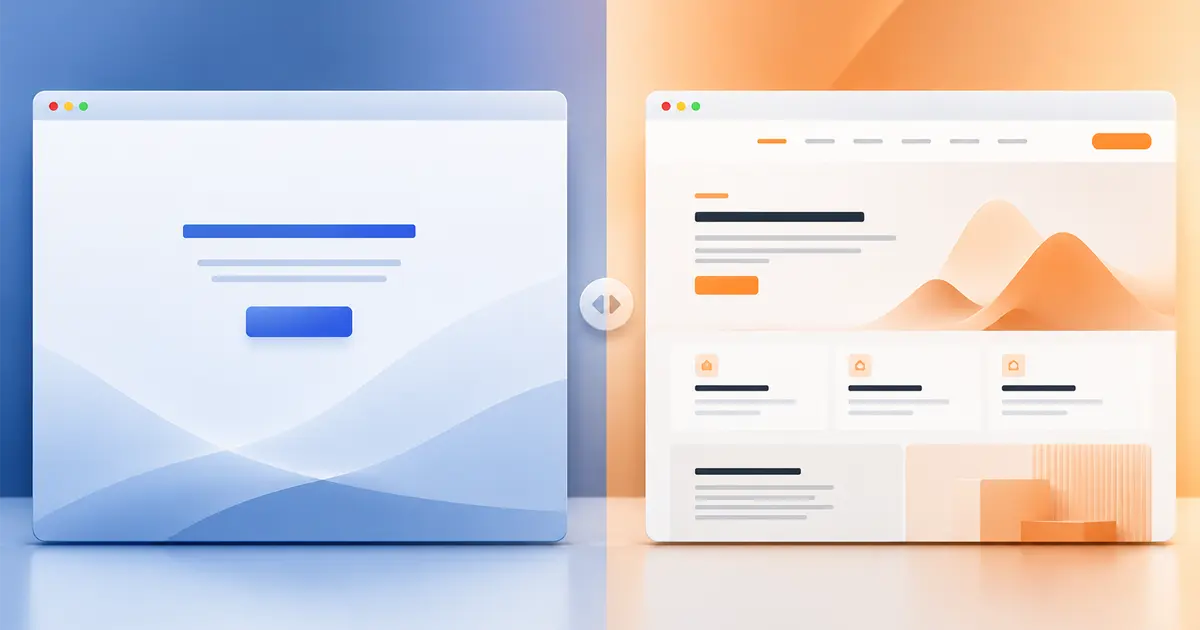
A landing page is one page built for one goal (order, buy, sign up). A website is several pages built for the whole business: services, blog, catalog. A landing page is faster and cheaper, but it won't replace a website if you have more than one offer or direction.
Almost every week someone reaches out saying "build us a landing page" — and ten minutes into the call it turns out they actually need a full multi-section website. And the reverse happens too: someone orders a "5-page site" while selling one specific product, when a single strong page would have done the job. Confusing the two formats costs money — either you overpay for sections you don't need, or your offer gets diluted where a single clear action was supposed to live. Let's break down what's what.
What a landing page actually is
A landing page is a single page built around one goal. Not "about us," not a "services catalog" — a specific offer: book a consultation, buy a course, register for an event. Headline, benefits, testimonials, a call-to-action button — the entire page structure leads the visitor toward ONE action. There's no ten-item navigation menu to get lost in — there's one path down the page to the sign-up form.
How a landing page differs from a multi-page website
- Number of pages. A landing page is one. A website is however many you need: services, blog, portfolio, a separate contact page.
- Goal. A landing page sells ONE offer. A website represents the business as a whole and can lead to several different actions at once.
- Navigation. A landing page has no menu leading "away" — only anchors to sections on the same page. A website has a full menu with page-to-page navigation.
- SEO. A multi-page site has a better shot at ranking for dozens of search queries — each page targeting its own intent. A landing page usually runs on paid traffic or a single specific search phrase.
- Timeline and cost. A landing page is faster and cheaper — less content, a simpler structure.
Not sure which format you need?
Tell us what you're selling and where you plan to drive traffic — we'll tell you whether a landing page is enough, or whether you should plan for a full website from the start.
When a landing page is the right choice
A landing page is the right call when:
- You're launching ONE product, course, or promotion and don't want the visitor's attention split.
- You're planning to run paid ads (Google Ads, Meta) to the page — the ad and the landing page should say the same thing, with no extra clicks sideways.
- You have a one-off event — a webinar, a sale, a cohort enrollment — with a clear date and deadline.
- You need to quickly validate an idea (MVP): whether people actually buy the product, before investing in a full website.
When a landing page isn't enough
If you have several services or product categories, need a blog for organic traffic, or customers search for you by brand rather than by a single promotion — a landing page will feel too narrow. One page physically can't hold structured information about 7 different services, let alone blog articles that keep pulling in traffic for months and years. In that case you need a full multi-page website — the same format we built for ourselves, by the way (just look at the menu above).
How much it costs and how long it takes
Thanks to its simpler structure, a landing page is generally both cheaper and faster than a multi-page website — we'll break down exact numbers and stages in the next article. In short: LuloTech's base website-development package covers both formats — a single strong page or a full multi-page site — depending on what your business actually needs.